

As government and institutional funding becomes less predictable, many nonprofits are looking for new ways to support their programs. Although individual giving isn’t a new fundraising strategy, Charity Navigator (CN) is working to bridge the gap between donors and nonprofits with its accessible, unbiased nonprofit rating system. If your organization wants to increase funding, improving your CN rating may be a great place to start.
What is Charity Navigator?
Charity Navigator is a New Jersey-based nonprofit organization established in 2001 to help donors objectively evaluate charities by providing independent, objective information. While CN engages in various activities in the nonprofit accountability and transparency space, it is best known for its charity ratings service. CN has collaborated with nonprofits, donors, academics, and other experts to develop a methodology that can numerically rate almost every 501(c)(3) public charity that files an annual Form 990. (Ratings are not provided for private/family foundations, churches that are not required to file a 990, nonprofits that are not tax-exempt under 501(c)(3), and very small organizations that file a 990-EZ or 990-N.)
What is the Charity Navigator Ratings System and How Does it Work?
Ratings are based on publicly available Form 990 data and self-reported data that nonprofits provide to CN. For each of the 245,000 charities rated to date, CN calculates a score ranging from ‘less than 50’ to 100. This score is then assigned a star rating and a corresponding assessment level:
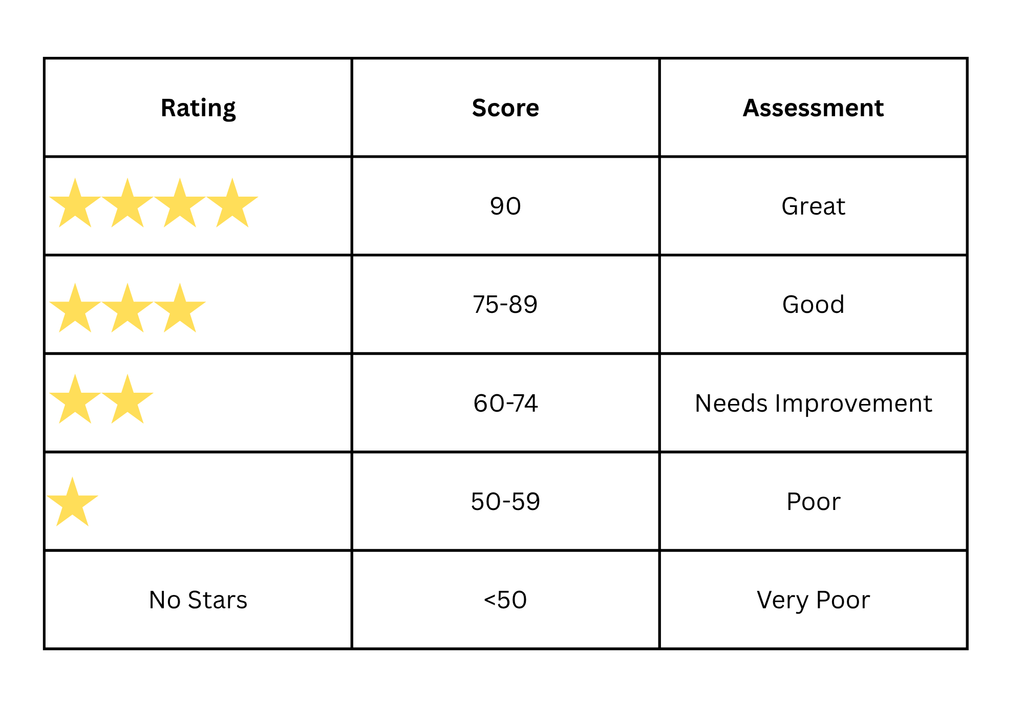
CN evaluates nonprofits in four broad areas or “beacons.”
- Accountability and Finance
- Impact and Measurement
- Leadership and Planning
- Culture and Compensation
Data for beacon #1 comes from publicly available IRS Form 990 filings, while beacon #2 data is obtained from self-reported metrics that organizations provide on CN’s nonprofit portal. Beacons #3 and #4 combine self-reported data with Form 990 data.
Donors can search for an organization from CN’s homepage and view its profile for free without needing to register. A nonprofit’s profile page displays the organization’s percentage score, star rating, and number of beacons completed that determine the score. A nonprofit’s profile will be tagged as “complete” if all four beacons have been evaluated. Organizations that have not submitted a profile will have a score based solely on beacon #1 from Form 990 data.
Where Exactly Does a Nonprofit’s Rating Come From?
An organization’s rating is based on both qualitative and quantitative metrics, ranging from the existence of a whistleblower policy to employee benefits spending. Certain metrics are financial, while others reflect best practices in board governance and internal controls. Some metrics apply only to certain nonprofits, such as organizations exceeding specific revenue thresholds. For
example, only donor-funded organizations with annual revenues greater than $50 million are penalized for not reporting the CEO’s salary on the Form 990 filing (even though the IRS requires all Form 990 filers to report this information). While some metrics apply to all organizations, certain nonprofits may be evaluated more harshly based on organization type or size.
Weighted average scores are computed using all available information; metrics lacking data are excluded so nonprofits are not penalized for an incomplete profile.
Why Should a Nonprofit Care About Its Rating?
How concerned you are with your nonprofit’s CN rating may depend on where your organization gets its funding. CN fills a unique gap in the individual donor space by providing a single reference tool to evaluate charities before giving. Most individual donors lack the clout to compel nonprofits to share the information they commonly provide to institutional funders.
Moreover, individual donors often lack the time or expertise to analyze publicly available Form 990 data. A CN score can be a major factor in fundraising outcomes for nonprofits driven by individual giving.
How Can a Nonprofit Optimize Its Rating?
While you might not have complete control over your nonprofit’s CN rating, there are four practical steps you can take to enhance your score.
- Check Your Existing Rating
If you are a 501(c)(3) (but not a church or a private foundation) and annually file a standard Form 990 (not a 990-EZ or 990-N), then your organization probably has a rating at charitynavigator.org. If you already have a four-star rating and score in the high 90s, then you may be content to let sleeping dogs lie. But for many nonprofits, a cursory review of their CN profile can identify errors, possibly from inaccuracies in your Form 990 filings.
2. Verify Accuracy of Underlying Data
CN’s rating methodology guide provides detailed information on exactly what data from the Form 990 is used to determine a given metric and how that metric is scored. Some basic number crunching can help you confirm whether key metrics displayed on your profile are accurate. It’s also a good idea to review your Form 990 filings for the most recent 3 years to determine if the
relevant data was reported correctly. Inaccuracies on your Form 990 will invariably lead to errors in your CN score.
3. Ensure Form 990 Filings Going Forward Are Accurate
If you’ve identified errors on past Form 990 filings (step 2), discuss amending those returns with your nonprofit CPA, EA, or tax attorney. Also, take steps to ensure that future filings report information accurately. Page 6 of the 990 is a good place to start because it provides data for many of the CN metrics. Because Form 990 is used to demonstrate compliance with the Internal
Revenue Code, answering questions incorrectly may not only affect your CN rating but also jeopardize your 501(c)(3) status. Therefore, your tax preparer should be well-versed in tax- exempt organizations, and you should carefully review and understand the filing before submitting it to the IRS.
4. Evaluate and Enhance Your Practices
Once you have ensured your Form 990 is accurate, the next step is to identify areas for improvement. The Rating Methodology Guide offers a goldmine of opportunities to adopt best practices and clearly explains what CN is looking for. Consider establishing a working group within your nonprofit’s audit or finance committee to identify and prioritize next steps. Seek guidance from your nonprofit CPA or independent auditor to learn what similarly situated peer organizations are doing. When determining which of the best practices to implement, you may find it helpful to sort them into categories according to the amount of time and resources
required. Some improvements can be implemented immediately with relative ease, while others may require long-term planning or might not even be feasible for your organization.
Here are some practices you may wish to consider implementing in the near term if they are not already in place (these are the low-hanging fruit):
Maintain a governing board with at least three members, the majority of whom are independent.
Consistently maintain minutes of meetings of the governing board (and committees authorized to act on behalf of the board).
Maintain an organizational website and list your website URL on the Form 990.
Post your Form 990 filings on your website (having your Form 990 posted on a third- party website does not count for this metric).
Circulate the annual Form 990 to all board members before submitting it to the IRS.
Maintain whistleblower, conflict-of-interest, and document retention and destruction policies. (The internet contains a wealth of information to help you enact such policies.)
Avoid loans between the organization and its officers, directors, or key employees.
Additional steps that can improve your score, but might require more planning and resources to implement:
Provide employee benefits (health insurance, retirement contributions, etc.) that cost at least 14 cents for every dollar of salary expense.
Undergo an independent audit and maintain an audit committee if annual revenue is at least $2 million (or a financial statement review if annual revenue is at least $500,000 but less than $2 million).
Minimize debt in relation to assets. Ideally, an organization should have no more than 30 cents of debt for every dollar of assets on its balance sheet.
Maintain enough cash in your bank accounts to cover at least one month’s worth of expenses.
One specific metric from CN’s ratings methodology has drawn controversy in the nonprofit sector. CN would like you to spend at least 70% of your total expenses on program services (versus administration and fundraising) if your annual budget is at least $500,000, or at least 85% on program services if your annual budget is at least $2 million. As an independent auditor, I’ve found it can be difficult for organizations to reach these levels without resorting to questionable accounting practices or underinvesting in infrastructure. Conversely, I have seen situations where organizations inadvertently understate program expenses due to a problem with their cost allocation methodology. When in doubt, seek guidance from your nonprofit’s CPA or independent auditor. (For an interesting counterargument to CN’s inclusion of the program expense ratio, see the Stanford Social Innovation Review’s article on the Nonprofit Starvation Cycle.)
5. Monitor Your Score
After you complete the first 4 steps, monitor your CN profile. As you continue to adopt CN’s defined best practices, you should start to see those changes reflected in your score. However, your score may take time to improve because some metrics average the most recent three years of Form 990 data.
While not everyone in the nonprofit sector loves Charity Navigator or its cookie-cutter ratings system, many donors still use it to screen nonprofits. Improving your score can be a great starting point if your organization wants to boost individual giving. But remember, your CN rating is just one way to assess organizational performance. The ultimate goal shouldn’t be a high rating, but rather optimizing program outcomes through efficient, effective resource deployment.